
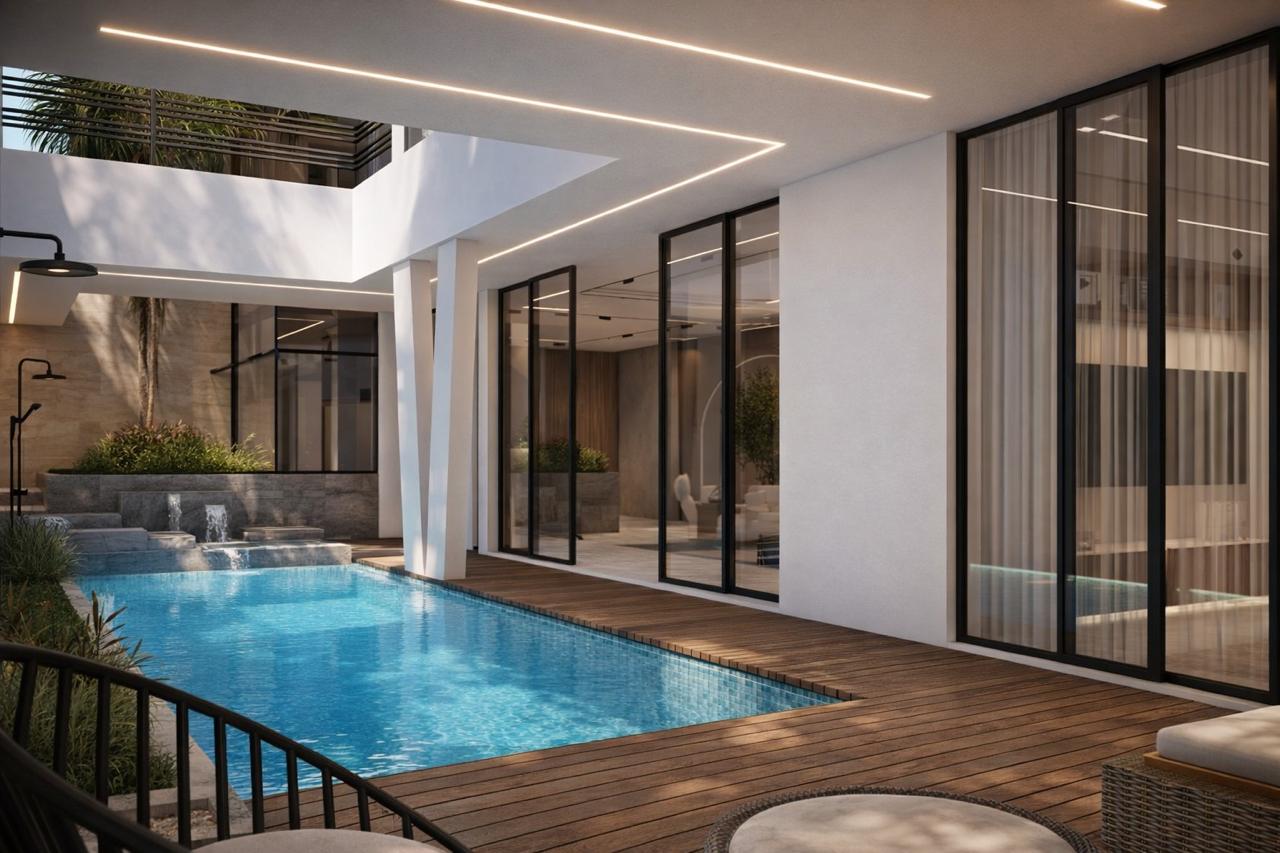
For decades, commercial environments have been defined by harsh lighting, cubic partitions, and sharp right angles. The corporate grid was designed for maximum density, but rarely for human psychology. At FID, we believe that environments profoundly shape cognitive function, and the transition away from rigid geometry towards organic forms is more than a trend—it is a psychological necessity.
The Subconscious Impact of Curves
Neurological studies have shown that humans have an innate preference for curved visual objects. Sharp angles in architecture often trigger subtle, subconscious responses associated with threat or danger in the amygdala. Conversely, sweeping curves, arches, and rounded edges stimulate the anterior cingulate cortex—the region of the brain associated with emotion and reward.
“When we remove the harsh edges of a room, we remove the harsh edges of the mind. Creativity thrives in spaces that feel safe and unbounded.”
In our recent design for a leading tech firm in Dubai, we entirely eliminated 90-degree corners in the communal zones. Hallways gently meandered rather than cutting sharply, and meeting pods were designed as acoustic, circular sanctuaries. The result was a measurable decrease in ambient stress and a reported increase in spontaneous, collaborative encounters.
Materiality Meets Form
Shape alone is not enough; the materials must align with the geometry. A curved wall clad in cold steel still feels clinical. However, when that same curve is finished in warm, textured plaster or vertical timber slats, it mimics the organic flow found in nature (Biophilia).
As we continue to explore the boundaries of interior architecture, our focus remains clear: designing spaces that look beautiful, but more importantly, spaces that feel right. The psychology of shapes is just one tool we use to craft environments that heal, inspire, and elevate the human experience.
